Commuting from Rockland County to NYC: A Local Guide to Trains, Buses, Ferries & DrivingOne of the first questions I hear from buyers considering Rockland County is:“But how do people

Dated: August 13 2026
Views: 256
One of the first questions I hear from buyers considering Rockland County is:
“But how do people commute into Manhattan?”
The answer is that Rockland County doesn't have one single commuting route into New York City. Depending on where you live, where you work in Manhattan, and whether you prefer driving, taking a train, riding a bus or combining several modes of transportation, there are a number of options.
Most commuters are ultimately trying to reach either Grand Central Terminal on the East Side or Penn Station on the West Side, so I've broken down the most common options below.
2026 note: Fares, schedules, tolls and parking fees change regularly. The prices and travel times below are approximate and are intended for comparison rather than trip planning. Always check the transit provider before traveling.
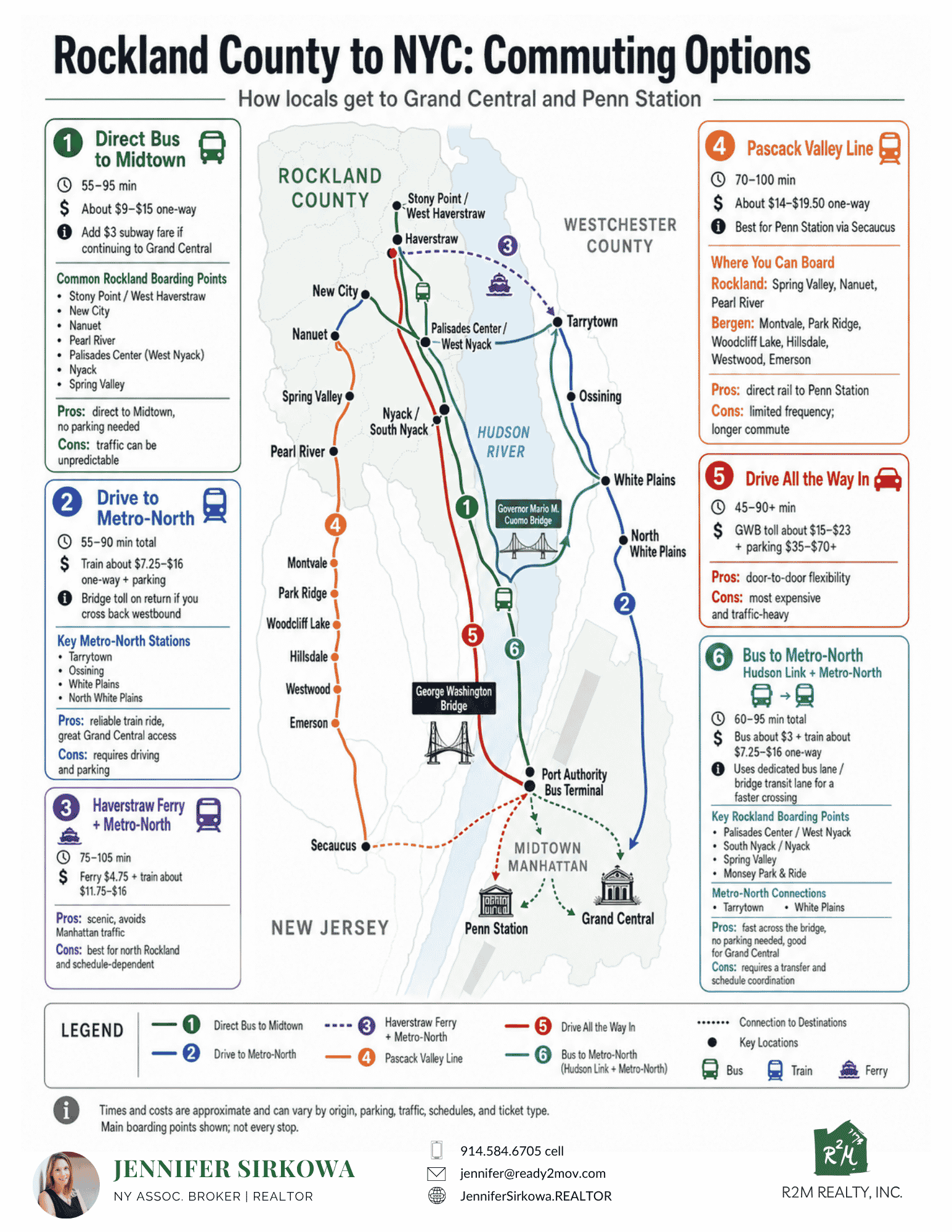
| Option | Best For | Approx. Travel Time | Approx. One-Way Cost* |
|---|---|---|---|
| Direct commuter bus | Midtown / Port Authority | 55–95 min | Varies by boarding point |
| Drive to Metro-North | Grand Central | 55–90 min | Train + parking + bridge toll |
| Hudson Link + Metro-North | Grand Central | 60–95 min | Bus + approximately $10–$16 train |
| Haverstraw Ferry + Metro-North | Grand Central | 75–105 min | $4.75 ferry + $11.75–$16 train |
| Pascack Valley Line | Penn Station / West Side | 70–100 min | Approximately $14–$20 |
| Drive into Manhattan | Maximum flexibility | 45–90+ min | Toll + parking + fuel |
*Costs vary considerably depending on your starting point, peak/off-peak travel, parking and ticket type.
For many Rockland residents, the simplest option is also one of the most overlooked: take a commuter bus directly into Manhattan.
Rockland Coaches/Coach USA operates commuter service between Rockland County, Bergen County and New York City, with service into the Port Authority Bus Terminal in Midtown.
Depending on the route and schedule, Rockland boarding areas include communities and park-and-ride locations such as:
Coach USA's published route information specifically identifies service through locations including Stony Point, West Haverstraw, New City, Bardonia, Nanuet, Pearl River and Palisades Center, although individual routes and schedules vary.
The Palisades Center Park & Ride is particularly convenient for central Rockland residents. The commuter lot is located near Thruway Exit 12 and has approximately 900 spaces.
Port Authority is at 42nd Street and Eighth Avenue.
From there:
The standard NYC subway/local bus fare is $3.00 in 2026, and OMNY allows riders to tap a credit card, smartphone or compatible device directly at the turnstile.
Direct ride into Manhattan. No train transfers and no Manhattan parking.
It can also be an excellent option for someone who wants to leave the car at a suburban park-and-ride rather than drive across the Hudson every day.
Traffic.
A bus can be wonderfully convenient when traffic is moving and considerably less predictable when it isn't. Commuters should compare peak-hour schedules carefully.
Another very popular strategy is to drive from Rockland County across the Governor Mario M. Cuomo Bridge and pick up Metro-North in Westchester.
This is particularly attractive for commuters whose office is near Grand Central Terminal.
Some stations worth comparing include:
Often one of the most logical choices for residents of Nyack, South Nyack, West Nyack, Blauvelt, Orangeburg and surrounding communities.
Farther north, but a useful alternative depending on your starting point, parking availability and train schedule.
Located on Metro-North's Harlem Line and worth considering for commuters coming from central or western Rockland.
Another Harlem Line option that can sometimes work better for parking or train scheduling. Metro-North has specifically identified North White Plains as an alternative parking location for West-of-Hudson commuters.
Metro-North peak fares apply to trains arriving at New York terminals during weekday morning rush hours and departing during designated weekday evening rush periods. Exact fares depend upon the station and time of travel.
For a standard passenger vehicle using a properly mounted NY E-ZPass, the regular 2026 Governor Mario M. Cuomo Bridge toll is $7.25.
Eligible Rockland and Westchester County residents enrolled in the resident discount plan pay $5.80 per trip, with no minimum number of trips required.
There is also a commuter discount plan for qualifying frequent users.
Once you're on the train, the ride into Grand Central is relatively predictable and doesn't depend on Manhattan traffic.
This option also gives commuters flexibility: if one station's parking, schedule or service doesn't work well, another Westchester station may.
You're combining a drive, bridge crossing, parking and train ride.
Parking availability and fees should be investigated before deciding that a particular Metro-North station will be your everyday commute.
Here's an option that people moving to Rockland County often don't know exists.
Instead of driving across the Cuomo Bridge to catch Metro-North, you can take the Hudson Link bus.
Hudson Link is a regional bus service connecting Rockland and Westchester counties, including connections to Metro-North. The MTA specifically lists Hudson Link as a connecting service for Metro-North's Hudson Line.
Depending on the route, Rockland-area boarding locations can include:
Connections are available to destinations including Tarrytown and White Plains, making this an especially interesting option for commuters headed to Grand Central.
For example, the H07 operates between the Palisades Center area and Tarrytown, while other routes serve the broader Route 59 corridor and White Plains.
Hudson Link was designed specifically to improve transit between Rockland and Westchester across the Cuomo Bridge corridor.
That means you can potentially:
Park in Rockland → take Hudson Link across the river → board Metro-North → arrive at Grand Central.
No Westchester parking. No driving across the bridge yourself.
Potentially one of the smartest hybrid commutes for someone headed to the East Side.
It eliminates the need to find Metro-North parking in Westchester while still giving you the reliability of a train for the longer portion of the trip.
You have to coordinate two schedules.
A missed bus-to-train connection can add time to the commute, so this option is worth test-driving during your actual commuting hours before relying on it daily.
For residents of North Rockland, one of the most unique commuting options in the region is the Haverstraw–Ossining Ferry.
The ferry travels across the Hudson River from Haverstraw to Ossining, where passengers transfer to Metro-North's Hudson Line for the trip to Grand Central.
The ferry is specifically scheduled to connect with Metro-North trains.
The adult one-way ferry fare is $4.75.
Metro-North currently lists the Ossining-to-Grand Central fare at:
Another benefit: parking at the Haverstraw ferry dock is free.
No bridge traffic.
No Manhattan driving.
Free parking.
And, as commutes go, crossing the Hudson by ferry isn't a bad way to start the morning.
This option makes the most sense geographically for residents of northern Rockland.
Because you're coordinating a ferry and train, schedules matter more than they do with a simple drive-to-train commute.
Rockland County actually does have train stations — they're simply on the west side of the Hudson.
Metro-North provides service at three New York stations on the Pascack Valley Line:
Depending on where you live, some nearby northern Bergen County stations may be equally convenient, including:
All are part of the Pascack Valley rail corridor.
This is important:
The Pascack Valley Line does not normally run straight from Rockland County into New York Penn Station.
For Penn Station, passengers generally travel to Secaucus Junction and transfer to another NJ TRANSIT train into New York Penn Station. The line also serves Hoboken Terminal.
For someone working near Penn Station, Hudson Yards, Chelsea or the West Side, this can nevertheless be a very practical commute.
You can board a train without crossing the Hudson River first.
That makes Pearl River, Nanuet and Spring Valley particularly interesting for buyers who prioritize rail access.
Service isn't as frequent as many Metro-North East-of-Hudson lines, and reaching Penn Station typically involves the Secaucus transfer.
Always compare the specific trains you would actually use.
And, of course, there's always the car.
Depending on where you live in Rockland, drivers generally head south toward the George Washington Bridge and then continue into Manhattan.
Travel time can vary enormously.
Very early in the morning, the drive can be surprisingly quick.
During peak commuting periods?
That's a different story.
Port Authority tolls vary based on E-ZPass status and other factors, and the Port Authority revised toll rates again in 2026.
Then add Manhattan parking, which can easily become the largest daily commuting expense.
Maximum flexibility.
Door-to-door transportation.
Useful if your workday involves appointments in multiple locations or irregular hours.
Traffic, tolls, fuel and parking make this potentially the most expensive and unpredictable option.
It depends much more on where you work in Manhattan than people initially realize.
Start by comparing:
Hudson Link → Metro-North
Drive → Tarrytown/Ossining/White Plains → Metro-North
Haverstraw Ferry → Ossining → Metro-North
Start with:
Pascack Valley Line → Secaucus → Penn Station
or
Direct bus → Port Authority, followed by a short walk or subway ride.
A direct commuter bus into Port Authority may actually be one of the simplest options.
Don't evaluate a Rockland County home simply by asking:
“How far is this from Manhattan?”
A better question is:
“What does my actual commute look like from this particular house to my particular office?”
Two homes only 10 minutes apart can have very different commuting advantages.
One may be five minutes from the Palisades Center Park & Ride.
Another may be closer to Pearl River's train station.
Another may put you near Nyack and the Hudson Link.
And a home in North Rockland may make the Haverstraw ferry surprisingly practical.
If commuting will be a major factor in your home search, test the route during the hours you actually expect to travel before making a decision.
There are train stations in Spring Valley, Nanuet and Pearl River on the Pascack Valley Line. However, trains do not normally run directly into New York Penn Station. Penn Station riders generally transfer at Secaucus Junction.
For many residents, Metro-North from Westchester is the most straightforward rail option to Grand Central.
You can drive to a station such as Tarrytown, Ossining, White Plains or North White Plains, or use Hudson Link to reach a Metro-North connection without driving across the bridge yourself.
The Pascack Valley Line through Secaucus is one of the most logical rail options, particularly for residents near Pearl River, Nanuet and Spring Valley.
Another good option is a commuter bus into Port Authority followed by a short walk or subway ride south to Penn Station.
Yes. Rockland Coaches operates commuter service between Rockland County and Manhattan, primarily serving the Port Authority Bus Terminal.
Boarding locations vary by route and schedule.
Yes. The Palisades Center / West Nyack commuter lot is one of Rockland's major transit hubs and is served by commuter bus routes.
It is also a major boarding location for Hudson Link service across the Cuomo Bridge.
Yes. Hudson Link connects Rockland County with Westchester and Metro-North connections including Tarrytown and the White Plains area.
This can eliminate the need to drive across the bridge and park at a train station.
Not directly to Manhattan.
The Haverstraw–Ossining Ferry crosses the Hudson to Ossining, where passengers connect with Metro-North trains to Grand Central.
As of 2026, the adult one-way fare is $4.75. A 10-trip ferry ticket is also available.
As of 2026, the standard subway and local bus fare is $3.00. Riders can pay using OMNY with a contactless card, smartphone, wearable device or OMNY Card.
Eligible Rockland and Westchester County residents with a qualifying NY E-ZPass account can enroll in the Governor Mario M. Cuomo Bridge Resident Plan.
The 2026 resident rate is $5.80, compared with the standard NY E-ZPass passenger-vehicle rate of $7.25.
A realistic planning range is approximately one hour to an hour and a half, although some trips can be shorter and others considerably longer.
The biggest variables are:
That's why there really isn't one universal “Rockland County commute.”
Choosing the right town isn't only about the house, schools or property taxes. For commuters, transportation can make a huge difference in day-to-day quality of life.
I help buyers compare not just homes, but the practical details of living in Rockland County — including which commuting options make the most sense from different communities.
If you're considering a move and want help narrowing down which Rockland towns work best for your commute, reach out and let's talk about where you need to be, how often you commute and what type of commute you prefer.
Transportation information is provided as a general guide and was researched using publicly available transit information current as of August 2026. Schedules, fares, tolls, routes and parking policies are subject to change.

As lifelong Rockland County resident, Jennifer Sirkowa can put her insider knowledge to work for you. "Whether my client is a seller looking for the best service and experience, a first-time buyer loo....
Commuting from Rockland County to NYC: A Local Guide to Trains, Buses, Ferries & DrivingOne of the first questions I hear from buyers considering Rockland County is:“But how do people
Celebrate America's 250th Birthday:Your Town-by-Town Guide to Independence Day in Rockland CountyThere's something special about the Fourth of July in Rockland County. This year, communities across
Summer 2026 · Community GuideWhere to Keep Cool This Summer In & Around Rockland CountyBy Jennifer Sirkowa · R2M Realty, Inc.Summer in Rockland County means
🌸 WHY SPRING CLEANING MATTERSThere’s something undeniably energizing about throwing open the windows, letting in the fresh air, and giving your home a total reset. Spring cleaning goes
 The data relating to the real estate for sale on this web site comes in part from the Internet Data Exchange Program of the NJMLS. Real estate listings held by brokerage firms other than R2M Realty, Inc. are marked with the Internet Data Exchange logo and information about them includes the name of the listing brokers. Some properties listed with the participating brokers do not appear on this website at the request of the seller. Listings of brokers that do not participate in Internet Data Exchange do not appear on this website. All information deemed reliable but not guaranteed.
Last date updated: September 10, 2026 1:08 AM UTC Source: New Jersey Multiple Listing Service, Inc. "© 2026 New Jersey Multiple Listing Service, Inc. All rights reserved."
The data relating to the real estate for sale on this web site comes in part from the Internet Data Exchange Program of the NJMLS. Real estate listings held by brokerage firms other than R2M Realty, Inc. are marked with the Internet Data Exchange logo and information about them includes the name of the listing brokers. Some properties listed with the participating brokers do not appear on this website at the request of the seller. Listings of brokers that do not participate in Internet Data Exchange do not appear on this website. All information deemed reliable but not guaranteed.
Last date updated: September 10, 2026 1:08 AM UTC Source: New Jersey Multiple Listing Service, Inc. "© 2026 New Jersey Multiple Listing Service, Inc. All rights reserved."
 OneKey® MLS required Copyright, Source of Data and Disclaimer for IDX display
Information Copyright 2026, OneKey® MLS. All Rights Reserved.
The source of the displayed data is either the property owner or public record provided by non-governmental third parties. It is believed to be reliable but not guaranteed. This information is provided exclusively for consumers' personal, non-commercial use.
The data relating to real estate for sale on this website comes in part from the
IDX Program of OneKey® MLS.
OneKey® MLS required Copyright, Source of Data and Disclaimer for IDX display
Information Copyright 2026, OneKey® MLS. All Rights Reserved.
The source of the displayed data is either the property owner or public record provided by non-governmental third parties. It is believed to be reliable but not guaranteed. This information is provided exclusively for consumers' personal, non-commercial use.
The data relating to real estate for sale on this website comes in part from the
IDX Program of OneKey® MLS.
33. Required DMCA Notice
The Digital Millennium Copyright Act of 1998, 17 U.S.C. §512, the DMCA, provides recourse for copyright owners who believe that material appearing on the Internet infringes their rights under U.S. copyright law. If you believe in good faith that any content or material made available in connection with our website or services infringes your copyright, you (or your agent) may send us a notice requesting that the content or material be removed, or access to it blocked. Notices must be sent in writing by email to DMCAnotice@MLSGrid.com. The DMCA requires that your notice of alleged copyright infringement include the following information: (1) description of the copyrighted work that is the subject of claimed infringement; (2) description of the alleged infringing content and information sufficient to permit us to locate the content; (3) contact information for you, including your address, telephone number and email address; (4) a statement by you that you have a good faith belief that the content in the manner complained of is not authorized by the copyright owner, or its agent, or by the operation of any law; (5) a statement by you, signed under penalty of perjury, that the information in the notification is accurate and that you have the authority to enforce the copyrights that are claimed to be infringed; and (6) a physical or electronic signature of the copyright owner or a person authorized to act on the copyright owner\'s behalf. Failure to include all of the above information may result in the delay of the processing of your complaint.
Show More...